
250 Words on Cursive

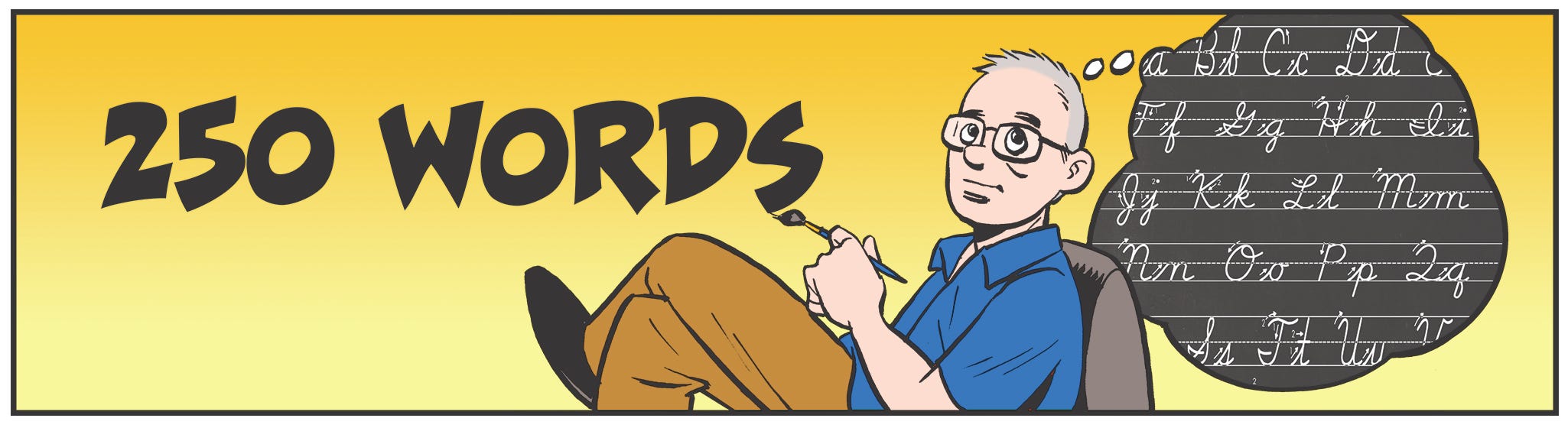
I hear that schools don’t teach cursive anymore. Nobody needs to handwrite when everybody types. Dump your quill and parchment in the dustbin, Pops!
I strongly disagree but can’t back up my opinion with a rational argument, only an aesthetic one: I like cursive. I remember learning cursive and feeling it rewire my brain, so that writing became less like typography and more like sketching. Letters swooped and looped and interconnected; writing in cursive changed the way I conceived and transmitted ideas. The medium shaped the message.
I also appreciate how handwriting changes over time. Anyone who’s read the Constitution knows that the so-called “long S” used to look like a tall “f” (“Congrefs”), but you don’t need to go back centuries to see orthographic evolution. When I learned cursive, capital “G” was a loopy-cornered block, “Q” was a big number “2,” and “S” looked like a treble clef. When my daughters learned it a few decades later, they were all streamlined to more sensible modern forms.
Cursive has life and personality. One glance at my mother’s instantly recognizable handwriting transports me decades into the past. A person’s signature represents commitment and gravitas. It becomes their avatar, which speaks for them when they can’t speak for themselves.*
I confess I’m judgmental about people who can’t write cursive. If you’re an adult who still block-prints like a seven-year-old I will think less of you, and I’m sorry. It’s not your fault. We failed you, even if I can’t quite explain how.
* To discourage forgery, I actually have two signatures—one I use to sign books and another I use for real life—and it’s like they’re two different people. Book-Brian is more fun and outgoing than Real-Life-Brian. I can see it in their handwriting.
An addendum I didn't have space to fit into a 250-word essay: I took a year of Russian in college, and so learned cursive Cyrillic. One Russian letter that was undergoing a shift was a lower-case "d," which formerly looked like a lower-case Greek delta (∂) but was evolving to look like a lower-case English "g." I persisted in writing the old-style ∂ just because I liked the way it looked and it was more fun to draw, until one day a native-Russian-speaking T.A. told me I wrote like her old grandma. Sometimes progress takes the fun out of everything.
We played school a lot when we were little, so I learned to print on the blackboard like a teacher in nice legible letters. But I have boxes of stuff written in cursive and I was once legible in that as well. No more. When I write on paper, first I have to find paper, and then find a pen, and then find a pen that still works. I went first to typing in college and since then to word processors. But I do remember Stan Freburg:
Franklin: The purfuit of happineff?
Jefferson: That's "pursuit of happiness."
Franklin: Well, all your S's look like F's.
Jefferson: It's very "in."
Franklin: Oh, well, if it's "in" ...